


Syllabus: GS3/Science and Technology
Context
- Growing digital adoption in India is driving demand for reliable data infrastructure, making cloud computing central to storing data and supporting digital services.
What is Cloud Computing?
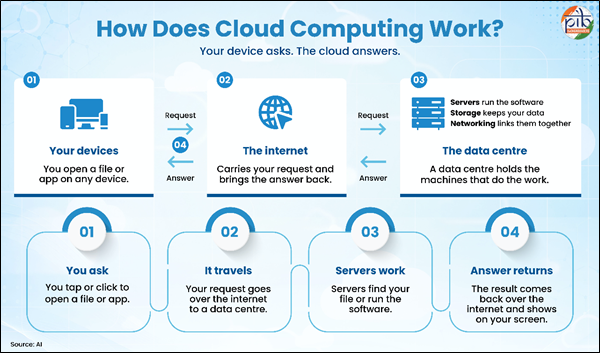
- Cloud computing enables users to access computing resources, including data storage, servers, software and processing capabilities, over the internet.
- Instead of purchasing and maintaining their own servers, organisations can use these resources as needed.
- For example, Google Drive allows users to store documents online and access them across multiple devices.
- Cloud computing depends on physical infrastructure. Data centres house the servers, storage systems and networking equipment that make these services possible.
- A server room is a dedicated space housing computers that store data and run digital services.
Types of Cloud Models
- A public cloud uses infrastructure provided by a third-party provider and shared among multiple customers.
- For example, a business/video-streaming company serves millions of viewers from shared servers.
- A private cloud dedicates its infrastructure to a single organisation.
- For example, a state treasury office keeps payment and accounts data on a private cloud to manage sensitive administrative records with greater control over security.
- A hybrid cloud combines public and private cloud environments.
- For example, a municipal corporation keeps its property-tax payment portal on a public cloud and citizens’ records on a private one.
Types of Cloud Services
- Infrastructure as a Service (IaaS) allows users to rent computing resources such as virtual servers, storage and networks instead of buying physical equipment.
- For instance, an online retailer can lease cloud servers to host its website and scale computing capacity to accommodate surges in traffic during festive sales.
- Platform as a Service (PaaS) enables developers with tools to build, test and launch applications without managing the underlying infrastructure.
- For example, a team developing a mobile banking application can use a cloud platform to build and test its software.
- Software as a Service (SaaS) delivers ready-to-use software over the internet, with the provider managing updates and maintenance.
- Examples: Zoom for video conferencing.
- Serverless computing allows developers to run specific tasks without managing servers directly.
- The cloud provider manages the infrastructure and allocates resources when required.
- For example, an online shopping platform can automatically process an order when a customer completes a purchase.
Why does India need more cloud infrastructure?
- India’s expanding digital activity is generating large volumes of information that need to be stored, processed and protected.
- The country’s internet subscriber base reached 1,092.79 million in March 2026.
- Average wireless data consumption stood at 25.51 GB per subscriber per month, while total wireless data usage reached 285,376 petabytes during 2025–26.
- Cloud infrastructure helps meet these requirements by allowing organisations to expand their computing capacity as demand rises.
- Example: An examination portal, for instance, can increase resources during registration periods and reduce them afterwards.
- Cloud services in India: As of September 2026, India had empanelled 30 cloud service providers.
- Indian providers include Jio Platforms, Tata Consultancy Services, BSNL, ITI, RailTel, AdaniConneX and Yotta Data Services. International providers include Google Cloud India, Oracle India, Microsoft Corporation India and Amazon Web Services India.
- Data Centres as a Pillar of India’s Cloud System: Data centres house the servers and storage systems that power cloud computing.
- As of August 2026, India’s data centre capacity had reached 1.57 GW and is projected to grow to nearly 8 GW by 2030.
What is MeghRaj?
- MeghRaj, the Government of India’s Cloud Ecosystem, was launched in 2014 by the Ministry of Electronics and Information Technology to accelerate e-governance and optimize public ICT spending.
- MeghRaj 2.0 represents the second-generation iteration of this National Cloud Computing Initiative.
Initiatives taken by India
- In March 2026, MeitY issued a Cloud Selection Framework which provides structured guidance to Ministries and Departments for selecting cloud infrastructure based on data sensitivity and criticality.
- The FutureSkills PRIME Programme, launched in 2021 by MeitY–NASSCOM, promotes emerging-technology skills.
- It ranked 3rd globally in the European Commission’s Pact for Skills Report 2024 for industry-focused training in AI, cloud computing and data analytics.
- Complementing this initiative, the National Institute of Electronics and Information Technology (NIELIT) operates 56 centres, 750 affiliated institutes and over 9,000 facilitation centres, training professionals in cloud computing, AI, cybersecurity, blockchain and IoT.
Way Ahead
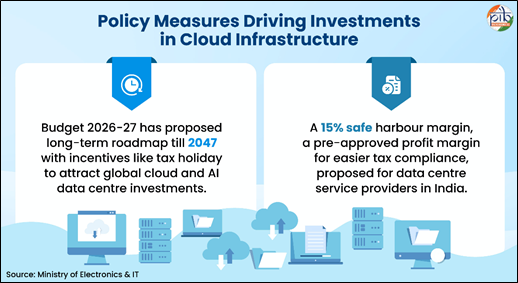
- India’s cloud ecosystem is witnessing rapid expansion, with the country’s cloud data capacity projected to grow nearly 4–5 times by 2030.
- Investments in data centres are augmenting domestic capacity, while targeted skill-development initiatives are cultivating a workforce equipped for cloud-based technologies.
- Together, these measures are fostering innovation and positioning cloud computing as a cornerstone of India’s long-term digital transformation.
Source: PIB
Previous article
Oil Spill off the UAE Coast Affects Desalination Plants
Next article
News In Brief 31-10-2026
